
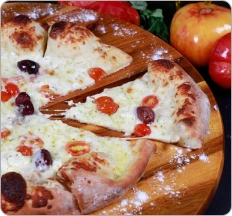
Most people don’t think about pizza size until they’re already at checkout, staring at a toggle between two numbers. Twelve or sixteen. Neither one comes with an explanation.
That’s usually when the second-guessing starts. Is 16 inches too much for two people? Will 12 inches leave someone still hungry twenty minutes later? The order gets placed anyway, and half the time it’s a guess.
The 12 inch vs 16 inch pizza decision isn’t actually complicated once you know what those four extra inches really mean. It’s more than most people assume, and less than others fear.
The Four Inches That Aren’t Just Four Inches
Here’s the part that trips people up: pizza size doesn’t scale the way it looks like it should.
Going from a 12-inch pizza to a 16-inch pizza sounds like a modest jump. Just four more inches across, right? Except pizza is round, and round things grow by area, not by width.
Run the numbers and a 12-inch pizza covers roughly 113 square inches. A 16-inch pizza covers about 201 square inches. That’s not a 33% increase. It’s closer to 78% more pizza, nearly double, for a diameter that only grew by a third.
This is the single most useful thing to know before choosing a size. A 16-inch pizza isn’t “a bit bigger.” It’s a genuinely different amount of food.
What a 12-Inch Pizza Is Actually Good For
A 12-inch pizza works best when you’re not trying to feed a crowd.
Think one hungry adult with room for leftovers, or two people splitting a pizza alongside something lighter, like a plate of garlic knots pulled fresh from the antipasti menu. It also holds up well as a solo dinner without turning into three days of cold slices in the fridge.
Pricing runs $14 for a plain cheese 12-inch, with toppings added at $2.50 each. Reach for one of Amedeo’s gourmet 12-inch pizzas, from the Titan Margherita to the Paolo, and the price sits in the $17 to $22 range depending on what’s piled on top.
There’s a third option too, and it’s easy to miss if you only ever order dinner: the lunch menu carries a 10-inch personal pizza with two toppings built in, sized for one person who doesn’t want a fridge full of leftovers by 2 p.m.
What a 16-Inch Pizza Is Actually Good For
A 16-inch pizza is built for the moments a 12-inch one runs out too fast.
Three to four adults sharing a meal, a family dinner where appetites swing wildly from one plate to the next, or a get-together where pizza is the entire point of the evening all call for the larger size. Plan for leftovers the next day, and 16 inches gives you a real shot at that too.
The plain cheese 16-inch starts at $18, with toppings at $3.50 each. The gourmet lineup at this size runs from $25 for the Titan Margherita up to $30 for the Leonardo, finished with pesto, chicken, spinach, cherry tomato, and pistachio.
The Math Nobody Mentions: Price Per Square Inch
Since a 16-inch pizza has almost double the surface area of a 12-inch one, it’s worth checking whether the price actually doubles too. It doesn’t.
Take the plain cheese pizza. A 12-inch costs $14 for about 113 square inches, working out to roughly 12 cents per square inch. The 16-inch costs $18 for about 201 square inches, closer to 9 cents per square inch.
Same pattern on the Titan Margherita: about 15 cents per square inch at 12 inches, dropping to around 12 cents per square inch at 16 inches.
In plain terms, the larger pizza stretches your money further per bite. That doesn’t make it the right call every time, since a party of two doesn’t need 16 inches of anything. But if you’re already leaning toward the bigger size for a group, the value case backs you up.
Matching the Size to the Actual Occasion
Size decisions get easier once you stop thinking about “how much pizza” and start thinking about what the meal actually is.
A quiet dinner for two rarely needs more than one 12-inch pizza, especially with something like the house salad or a cup of tomato basil soup alongside it.
A family dinner on a weeknight usually lands better with a 16-inch, particularly once kids are in the mix and portion sizes stop being predictable.
A casual get-together or game night almost always calls for 16-inch pizzas, and often more than one, depending on the headcount.
A solo lunch break is where the 10-inch personal size from the lunch specials earns its place, sized to be finished in one sitting rather than boxed up for tomorrow.
When Two Smaller Pizzas Beat One Large
Size isn’t the only variable. Sometimes the better move is two 12-inch pizzas instead of one 16-inch, and it comes down to toppings, not appetite.
If your table has a vegetarian, someone who wants extra meat, and a picky eater who only wants plain cheese, one large pizza forces a compromise. Two 12-inch pizzas with different toppings let everyone get what they actually want, without anyone picking mushrooms off someone else’s slice.
It costs a little more than a single 16-inch, but it solves a problem that size alone can’t fix.
A Note on the Gourmet Pizzas
Worth knowing before you order: Amedeo’s gourmet pizzas, the Bronzino, Donatello, Sandro, Giotto, Caravaggio Veggie, Amedeo, Paolo, and Leonardo, don’t allow topping substitutions. What’s listed is what arrives.
That actually simplifies things. With toppings already decided, the size question comes down purely to headcount and appetite, which is exactly the math covered above.
Let the Family Specials Do the Math for You
If sizing still feels like too much thinking for a Tuesday night, Amedeo has already solved it in bundle form.
The Wings Pizza Special pairs a large one-topping pizza with 12 breaded wings and two sodas for $40. Swap the wings for 15 chicken fingers and it becomes the Fingers Pizza Special at $45. For a pasta-leaning table, the Spaghetti Pizza Special and Lasagna Salad Special combine a large pizza or lasagna with a Caesar salad, no size calculator required.
These are worth remembering on any night when four people want four different things and nobody wants to be the one who decides.
A Quick Word on Slice Counts
Most pizzerias cut a 12-inch pizza into six to eight slices and a 16-inch into eight to ten, though this varies by shop. A commonly used planning rule is two to three slices per adult and about two per child, a useful baseline when you’re ordering for a group rather than a single meal.
That rule bends depending on what else is on the table. A pizza served alongside wings, salad, or garlic knots gets stretched further than a pizza served on its own.
Getting It Right the First Time
Twenty-plus years of serving pizza in the same Las Vegas neighborhood tends to teach a kitchen exactly how these two sizes get used in real life, not just on paper. That’s part of why the 12-inch and 16-inch options here cover such different ground instead of being small and big versions of the same thing: one is genuinely built for a quiet meal, the other for a full table.
Next time the size toggle shows up at checkout, it’s less of a guess. A 12-inch pizza covers a light dinner or a solo meal with leftovers. A 16-inch pizza is the better value for a group, provided the toppings work for everyone eating it.
Still unsure which way to go for your specific table? Browse every pizza, size, and price side by side, or call the team directly and describe who’s eating they’ll tell you straight rather than let you guess.